Showing posts with label interpretation. Show all posts

May 24, 2015

Some Expository Thoughts on the Gospel of Mark (part 1: Opening verses 1:1-3)

Mark 1:1-3 ESV
The beginning of the gospel of Jesus Christ, the Son of God. (2) As it is written in Isaiah the prophet, "Behold, I send my messenger before your face, who will prepare your way, (3) the voice of one crying in the wilderness: 'Prepare the way of the Lord, make his paths straight,'" 


Expository thoughts


The Gospel According to Mark is a book of testimony that bears witness to Jesus the Messiah. Mark opened his gospel narrative with the Greek word for “beginning” (ἀρχή). The opening word ΑΡΧΗ resembles the LXX opening word in Hosea 1:2 ΑΡΧΗ. The Greek version of Hosea speaks of the beginning of the Lord’s word as it began to come to Hosea. Mark 1:1 speaks of the beginning of the gospel as it began to be made known, in fulfillment of the predictions made by the prophet Isaiah (see Isa. 40:9; 52:7; 60:6; 61:1). In Hosea, the beginning was the beginning of the history of new divine revelation as it came to him. Perhaps in Mark, then, the beginning here means the history of the beginning of new divine revelation as it came in and through Jesus Christ. Mark referenced the book of Isaiah, but quoted a combination of Malachi 3:1, Exodus 23:20 and Isaiah 40:3. Isaiah chapter 40 is an announcement of anticipated good news which would be realized after the period of Israel’s exile in Babylon. The opening words are, “Comfort, comfort my people, says your God” (Isa. 40:1). These gracious words anticipated the comforting good news that Jerusalem’s warfare had ended, her iniquity had been pardoned and the wrath of God had been more than satisfied by double payment for her sins (Isa. 40:2). A voice calls for the preparation of the Lord’s way in the desert wilderness (40:3). Malachi 3:1 is used in context of Isaiah 40:3 by building on the concept of a predicted messenger who would prepare the Lord’s way in the wilderness. Malachi was written at a later date than Isaiah, yet Malachi reiterates the promise of a forerunner who prepares the way for the Lord to come. Both quotations are linked to the idea as it was first presented by Moses in Exodus 23:20, where God warns the people of Israel that they must obey the voice of his angel (messenger) whom he will send before them to keep them in their way as they traversed the desert wilderness. In each of the passages just mentioned, the Lord’s way in the wilderness indicates God’s own presence to deliver His chosen people Israel. Mark seems to have traced the concept of the Lord’s forerunner/messenger from its development in the history of revelation up to the point of John. He seems to have understood these predictions to have had the ability to reach beyond the prophet’s own experience at the time of their writing, as well as beyond Israel’s experience in returning from Babylon, and to reach forward to describe the period of fulfillment when the good news would become evident. In other words, Mark understood Isaiah’s prophetic announcement of good news to have been fulfilled by Jesus the Messiah. The basic premise of Mark’s writing is this: God has fulfilled His promises of good news by sending Messiah Jesus, His Son. The beginning of this good news is the ministry work of John the Baptist, who signals its inauguration.

September 3, 2011

Why and How to Read the Bible, part 2

“Declare his glory among the nations, his marvelous works among all the peoples!”
(Psalms 96:3 ESV)

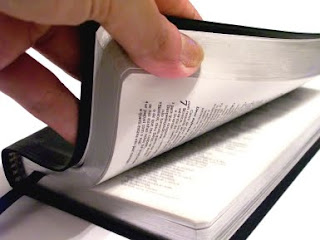
The Bible is not just a book. It is a book of books... made up of many writings by different writers, from different ages and different cultural settings. That's all it is from most non-religious points of view.

But from the Christian's perspective, the Bible is the Book of books, because it is the very Word of God (1 Thes 2:13; 2 Tim 3:16)! It is God's message to humankind in the timeless form of writing, so that all people around the world are able to understand it if they have access to a good translation. Ancient Scripture certainly must be understood in light of the time and culture in which it was originally written, but a lack of that knowledge should not stop any of us from perceiving the main subject and theme.

God is the main subject of the Bible, and the theme is his glory. Sure, it does focus on many different characters, such as Abraham and his wife, Sarah; their son, Isaac; Jacob; Jacob's family; Moses and the Israelites; Jesus and his apostles, and so on. However, it is God who constantly makes himself known to every new generation throughout Biblical history. As God was revealing himself to his people through his Word, those who were called were able to know him more intimately and were changed by that experience of knowing him.

This is why we must read the Bible: to know God as he has revealed himself in Scripture as Father, Son and Holy Spirit. How we read the Bible will determine whether we know him rightly. As Peter said, there are those who, because of their ignorance, twist the Scriptures to their own destruction (2 Peter 3:16). Christians, of all people, should be the most careful and humble of its readers.

We don't read everything in the same way. We don't read the newspaper like we read a text book, or a historical biography as if it were a fictitious novel. There are certain things we need to know before we begin reading anything. We need to know what we are reading and why it was written.

When you pick up a newspaper, you already know that it's a newspaper, and you know what it is intended for as a whole--to inform you about the news. It is a compilation of different kinds of literature, such as reports, articles, advertisements, announcements, and entertainment, which are intended to provide readers with a variety of news, facts, opinions, entertainment, coupons, and other information. You don’t read every section of the newspaper in the exact same way, but you take into account the differences in type of literature and purpose. We must do the same with the Bible.

By understanding what kind of book the Bible is and what it intended to make known to its original readers, things become significantly clearer to us. Learning these basic facts isn't hard if you have some basic information available. People often go wrong when they fail to take some of that information into account. We’ll look at ways that often happens later.

You can find helpful information about the Bible in study Bibles, Bible dictionaries, Bible encyclopedias and Bible handbooks (all of which can be accessed free on the Internet). They can help provide you with historical background to what you are reading, as well as other important facts to help you better understand Scripture. Such tools are meant to assist, not hinder your reading of God's Word. Wise disciples should put them to good use, seeking to handle God's Word with great care (Prov 18:15; 1 Tim 1:6-8; 2 Tim 2:15; 3:15).